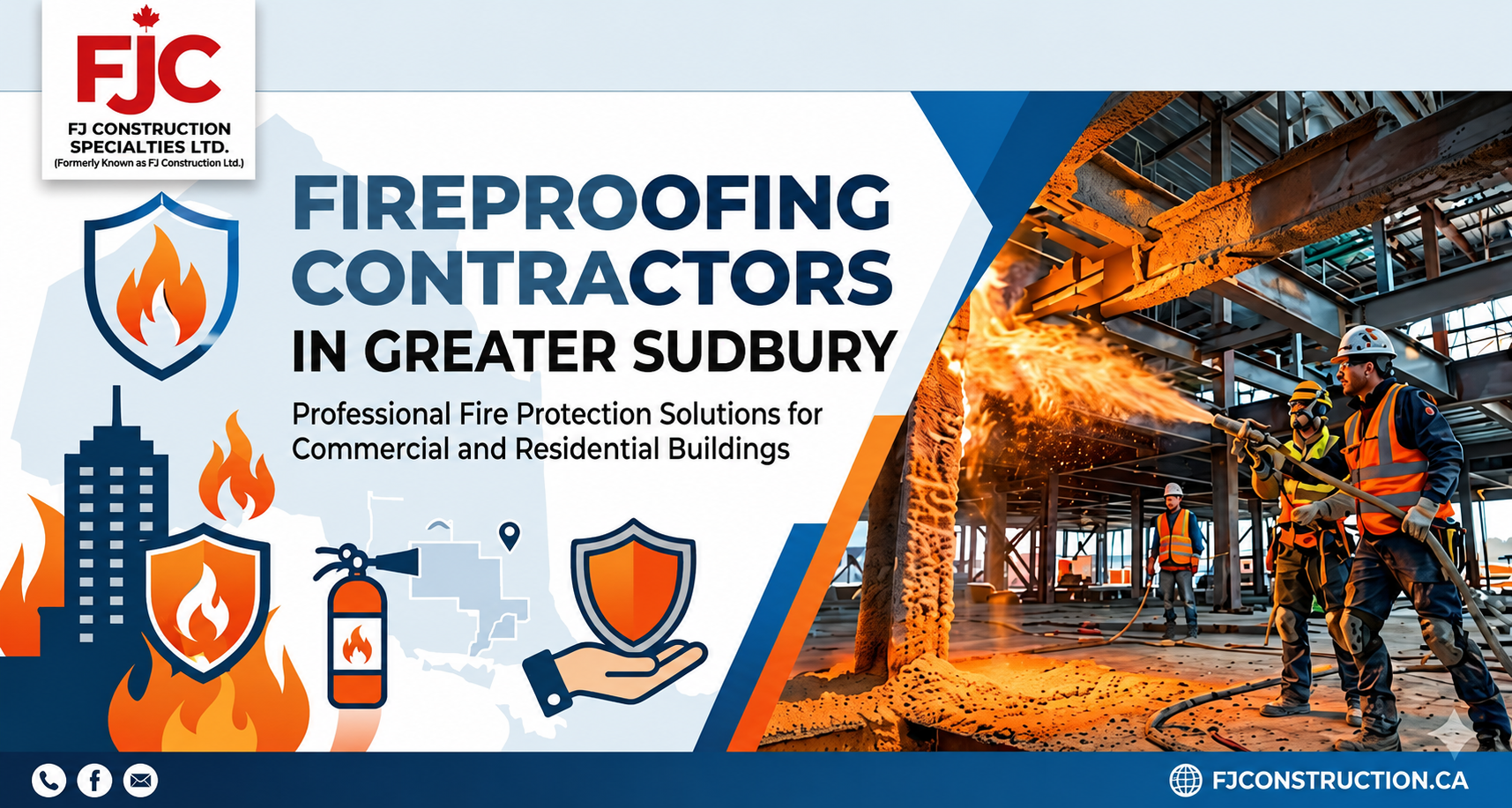
Like many other Eastern Canadian cities, Sudbury also faces a harsh winter and strong winds throughout the year. Moreover, the heavy-duty industrial work that keeps our local economy moving is all around this highly commercialized zone. Therefore, the buildings have to be tough. However, one risk always looms very heavily, and that is “Fire”. And simply we can’t ignore even the remotest of the chances.
Hence, whether we have a bustling office tower downtown, a busy retail facility on the Kingsway, or a massive mining operation in the Sudbury Basin, we need passive fire protection. It is a mandatory obligation. Literally, it is the backbone of your building’s safety ecosystem.
However, accidents happen, and when a fire breaks out, every single second counts.
That is where professional fireproofing comes in. It’s certainly not fancy or an addition to the aesthetics. It sits behind drywall, wraps around massive steel beams, and hides in the ceiling structure. But in case of the worst, it is the principal barrier that stands strong between a minor, containable incident and a structural collapse and life losses of catastrophic magnitude.
For businesses of varied scales, choosing the right fireproofing contractors Sudbury is not just checking a box for a municipal inspector, but it is about protecting human lives, safeguarding multi-million dollar capital investments, and serving as a rear guard to ensure that your business bounces back after a humongous crisis. In this article, we will deep dive into what passive fireproofing actually is and at the same time will discuss why your Greater Sudbury facility needs it, and how to choose the right team for the job.
What is Fireproofing?
Fireproofing is completely different from firestopping and fire extinguishing. It is a preventive and passive measure. It is applied to the structural elements directly during the construction or renovation phase. The objective is to prevent the building from collapsing if and when exposed to extreme heat arising from various unknown circumstances.
Purpose and Benefits
Think about a typical commercial or industrial fire that is fast, extremely hot, and can ravage huge premises in a very short time.
No point in guessing that unprotected structural materials are not manufactured to handle that kind of thermal stress for long. Fireproofing forms a protective, insulating barrier around these elements for a sufficient time, providing the precious time to the firefighters.
In short,
- Saves Lives: It delays structural failure, giving occupants more time to be evacuated.
- Protects First Responders: Sometimes, during emergencies, firefighters can’t enter the buildings immediately, fearing an immediate cave-in and eventual trapping.
- Minimizes Property Damage: It confines structural warping, saving millions between repairing a building and tearing it down completely.
- Reduces Insurance Premiums: Insurance companies love passive fire protection. Better fireproofing often equals lower operational risk and lower premiums.
Fire Resistance Ratings
This is the performance matrix measured in hours. Service providers usually measure in terms of hours, like 1 hour, 2 hours, 3 hours. Simply, it is the duration of the treated structural component for withstanding a standardized fire endurance test while maintaining its structural integrity. The Ontario Building Code (OBC) guides the determination of the exact requirements based on the building’s height, its occupancy type, and its proximity to other structures.
Commercial Fireproofing Services in Greater Sudbury
Commercial properties see a lot of foot traffic that consists of retail shoppers, office workers, students, patients, etc, that counts to hundreds or thousands of people under one roof. That is why the compliance code for a commercial fireproofing service in Greater Sudbury is so incredibly strict.
However, every commercial sector has its own unique layout challenges, structural realities, and specific risks that are an experienced contractor’s bread and butter.
Office Buildings
Due to the architectural necessity, modern office multi-story buildings often feature floor plans that are wide open. Hence, if a fire commences on a lower floor, the heat and smoke move upward rapidly. We at Fj Construction understand every emergency and requirement of comprehensive fireproofing for multi-story office complexes, protecting floor assemblies, elevator shafts, and support columns so that a localized fire stays localized.
Retail Facilities
From sprawling big-box stores to dense shopping centers, retail facilities present a unique challenge: high ceilings, large open spaces, and huge amounts of combustible inventory. Our team ensures that the structural steel supporting these massive roofs is thoroughly protected, keeping the escape routes viable for shoppers and staff alike.
Educational Institutions
Schools, college campuses, and university buildings need to be completely safe. We apply non-toxic, highly durable fireproofing materials. We follow strict institutional safety regulations to ensure long-term structural durability without compromising any qualitative parameters.
Healthcare Facilities
The challenges are immense because the vulnerable populations in Hospitals, clinics, and long-term care facilities can’t quickly get up and run out of a building during an alarm. Hence, the building must defend in place. Our High-performance fireproofing buys critical time for medical staff to execute controlled, safe evacuations of non-ambulatory patients.
Industrial Fireproofing Services in Greater Sudbury
Industrial environments are very different compared to commercial spaces. Because a fire in an industrial facility isn’t just fueled by drywall and office furniture. There are chemicals, heavy machinery fuels, gases, high-voltage electrical setups, and complex entanglements of human judgments, all of which can cause catastrophic fire.
Because of this, an industrial fireproofing service in Greater Sudbury essentially demands heavy-duty materials designed to withstand intense, rapid-heating “hydrocarbon” fires.
Manufacturing Facilities
Manufacturing plants operate around the clock with heat-generating equipment, welding stations, and complex assembly lines. The risk of an accidental thermal event is inherent in those circumstances. We apply specialized industrial-grade fireproofing that protects structural framing from intense localized heat spikes, keeping the core infrastructure of the plant intact.
Mining Operations
Sudbury is world-renowned for mining and is often called “hard rock mining capital of the world.” Here, the local surface facilities, processing mills, and headframes operate under extreme conditions, and the dust, vibration, and heavy impacts are part of the daily realities. Industrial mining structures require exceptionally rugged fireproofing solutions that won’t crack, flake, or degrade under harsh environmental stress. We know how to spec the right heavy-duty materials for the toughest mining environments.
Warehouses
Logistics hubs and warehouses often feature massive vertical storage racks and wide, open spans. They are also an integral part of mines and industrial structures, often nestled in the same premises, spreading over hundreds of acres of land and consisting of complex electromechanical arrangements. High-piled combustible goods mean that if a fire takes hold, it creates an intense, upward-rushing thermal column, not damaging just a portion of the warehouse but also a much wider set-up. Protecting the overhead roof trusses and central support pillars with high-density spray-applied fireproofing is vital to prevent total roof failure.
Processing Plants
Chemical processing, smelting, and water treatment facilities often involve corrosive environments alongside fire risks. Traditional fireproofing won’t cut it here. We utilize specialized industrial formulations that offer both exceptional fire resistance and chemical durability, ensuring your passive protection doesn’t dissolve over time.
Structural Steel Fireproofing Solutions
Below is a short but explanatory flow chart of how structural steel fails:-
[Steel Exposure to Fire]
│
▼
[Reaches 500°C / 932°F]
│
▼
[Loses roughly 50% of its structural strength]
│
▼
[Buckling, twisting, and eventual catastrophic collapse]
The reality is, steel does not need to melt to cause a disaster. It just needs to get hot enough to go soft. When structural steel softens, it buckles under the weight of the building, resulting in a total collapse in minutes.
That is why structural steel fireproofing is the most critical element of modern construction safety. By insulating the load-bearing beams, columns, girders, and joists, you prevent the steel from reaching that critical failure temperature.
Code Compliance Benefits
Investing in proper steel protection is almost mandatory to keep you on the right side of the law. Failing even a single inspection stops your project dead in its tracks. Worse, non-compliant buildings face massive fines, forced closures, and denied insurance claims after an incident. Working with an experienced commercial fireproofing contractor ensures your steel meets all Canadian building codes, underwriter requirements, and municipal bylaws from day one.
Types of Fireproofing Systems
No two buildings are identical, neither the solution to keep them safe. Hence, the material to fireproof an open-air parking garage is completely different from the material needed for a high-end corporate lobby. As a leading fireproofing company Greater Sudbury, we specialize in the three primary types of passive fire protection systems.
1. Cementitious Fireproofing
This is the most traditional and highly cost-effective method. It looks a bit like wet concrete when mixed and dries into a hard, durable, plaster-like finish.
- What it is: A blend of gypsum or Portland cement mixed with lightweight aggregates like vermiculite or perlite.
- Best for: Hidden structural steel, mechanical rooms, multi-story floor assemblies, and areas where the steel will be covered by a ceiling or drywall. The best environment for this protection is dry with minimal vibration.
- Pros: Highly affordable, exceptionally reliable, and offers great thermal performance for standard commercial builds.
- Cons: There are certain cons, like it is bulky and not great for aesthetics. Also, it can be brittle if there are heavy vibrations. Another con is that it can trap moisture if the environment is highly humid, resulting in corrosion.
2. Intumescent Fireproofing
Want to leave your structural steel exposed as a design feature? Cementitious sprays won’t work—they look rough and industrial. You need intumescent coatings.
- What it is: A specialized, high-tech paint applied directly to the steel.
- How it works: Under normal conditions, it looks like a sleek, smooth coat of paint. But when exposed to extreme heat (around 200°C), a chemical reaction occurs. The paint swells up massively, expanding into a thick, foam-like carbonaceous char that insulates the steel from the flames.
- Best for: Exposed steel columns, architectural atriums, modern office spaces, and airports.
- Pros: Highly aesthetic, customizable with topcoats, and takes up virtually no physical space.
- Cons: It is costly and needs meticulous workmanship. The contractor needs to prepare the surface correctly and ensure that the environmental conditions are perfect for the work. Hence, an experienced applicator like Fj Construction is so valued.
3. Spray Applied Fireproofing
Often referred to in the industry as SFRM (Spray-Applied Fire-Resistive Materials), this category includes both cementitious products and mineral wool fiber-based sprays.
- How it is applied: Sprayed directly onto prepared steel surfaces using heavy-duty pumping equipment.
- Best for: Rapid coverage of massive areas, complex roof deck geometries, and intricate industrial framing.
- Pros: Highly adaptable, excellent coverage over complex shapes, and provides additional acoustic and thermal insulation benefits to the building envelope.
- Cons: It is certainly an incredibly messy work—the wet overspray gets everywhere and creates a massive cleanup headache if the area isn’t perfectly sealed off first. Also, it can easily crack, flake, or trap hidden moisture against the steel if it gets knocked by heavy machinery or exposed to damp conditions.
How to Choose a Fireproofing Contractor
Passive fire protection is highly skilled and technical job. Thus, it is not something that can be delivered by any general contractor. A poor application is as useless and often dangerous as having no fireproofing at all. When you are ready to hire fireproofing contractor for your next project, look for these non-negotiable qualities:
Experience
How long have they been in business? Do they understand the specific challenges of Northern Ontario construction? Ask how many commercial or industrial projects they have completed in the Sudbury area.
Certifications
Fireproofing materials must be applied at exact, mathematically calculated thicknesses for achieving their rated hour performance. Your contractor must be manufacturer-certified to apply the specific product lines being used. Furthermore, they need to be fully bonded, insured, and tightly aligned with WSIB Ontario standards. At Fj Construction, we strictly adhere to all the requirements over a very long time.
Project Portfolio
Anyway, don’t just take their word for it. Look at their past work and clients’ testimonials. Have they worked on large-scale industrial sites? Have they handled delicate, aesthetic intumescent paint jobs? A reputable industrial fireproofing contractor will gladly share case studies or references from previous clients.
Safety Standards
Industrial and mining sites in Sudbury have some of the strictest safety orientations in the world. Your contractor’s crew needs up-to-date safety certifications, appropriate PPE protocols, and a flawless on-site safety record. If a contractor hesitates when you ask about their safety manual, walk away.
Fireproofing Services Cost Factors
Modern projects are costly. Hence, Budget matters. When you request a fireproofing contractor quote, the pricing isn’t pulled out of thin air. It is determined by several highly specific variable factors. Understanding these variables can help you optimize your project budget.
| Cost Factor | Impact on Overall Budget | Details |
| Building Size & Geometry | High | Larger surface areas require more material. Complex, hard-to-reach roof trusses require more labor and specialized staging/scaffolding. |
| Material Type | High | Cementitious sprays are highly economical. Intumescent coatings (fireproof paint) are a premium product due to the advanced technology and precise application required. |
| Fire Rating Requirements | Medium to High | A 3-hour or 4-hour rating requires a significantly thicker layer of material than a 1-hour rating, increasing both material volume and application time. |
| Surface Preparation | Medium | Steel must be clean. If your structural steel has existing rust, dirt, or incompatible primers, it must be blasted or cleaned before application so the fireproofing adheres properly. |
To get an accurate breakdown for your specific project, it is always advisable to request a detailed assessment. Experts can look at your architectural blueprints and give you an exact estimate of your fireproofing services cost.
Why Choose FJ Construction Specialties Ltd.
For any construction, it is always mandatory to protect its structural integrity. For that, you need a partner with a proven, unshakeable track record. That is exactly who we are. At FJ Construction Specialties Ltd., we have built a reputation over several years for uncompromising quality across Ontario.
Here is why local project managers, architects, and developers trust us with their buildings:
35+ Years of Experience
We are the veterans in the industry. With more than three and a half decades of hands-on experience under our belts, we have foresen, encountered, and solved virtually every passive fire protection challenge imaginable. From massive commercial complexes to high-risk industrial zones, our seasoned teams deliver flawless execution on tight construction schedules.
Commercial and Industrial Expertise
We don’t specialize in just one niche. We have dedicated teams equipped for both highly aesthetic commercial applications (like precision intumescent coatings) and rugged, high-output industrial spray applications (like heavy-duty cementitious coatings for processing plants). We tailor our approach to match the exact operational demands of your facility.
Canadian Code Compliance
The regulatory landscape can be a minefield. We know the National Building Code of Canada (NBC) and the Ontario Building Code (OBC) inside and out. Our installations are fully compliant with ULC (Underwriters Laboratories of Canada) and cUL standards. When we finish a job, you can rest easy knowing your facility will pass inspection with flying colors.
Q: What is fireproofing and firestopping?
A: The objective of fireproofing is to protect the main structural skeleton of the building (like steel beams and columns) from losing strength and resulting in collapse during fire. On the other hand, Firestopping is sealing up holes, joints, and pipe penetrations for fire-rated walls and floors that stop smoke and flames from moving from one room to another. Both are essential parts of passive fire protection.
FAQs
Q: Can I apply fireproofing paint myself to save on labor costs?
A: Absolutely not. Intumescent and cementitious fireproofing are highly regulated safety applications. They require precise mixing, specific ambient temperature controls, and specialized wet/dry film thickness gauges to ensure the coating is thick enough and also not excessive to meet code requirements. The code compliance inspections are very thorough, and to pass, the work must be done by a certified, professional contractor.
Q: How long does spray-applied fireproofing last?
A: Usually, it lasts during the entire lifespan of the structural member. However, if any major renovation work is performed, resulting in water damage or heavy mechanical impacts, the layer can be damaged and thoroughly inspected before any reparation work.
Q: Is cementitious fireproofing safe for indoor environments like schools or hospitals?
A: Yes. It is free from any harmful material that can release some volatile compounds in the air. So, it is perfectly acceptable for institutions like schools, clinics, and long-term care homes.
Q: Do I need to clean my structural steel before your team arrives?
A: Let us inspect the site first. We will let you know the exact surface preparation requirements that are mandatory before commencing the work. We will clearly define the demarcation of work between the client and us without ambiguity.
Q: How thick does the fireproofing layer need to be?
A: The short answer is “it depends”. Every structure and building is unique. Hence, the thickness is calculated using code-specified formulas that take into account the specific shape and mass of the steel structural elements and the fire resistance rating (1hr, 2hr, 3, or 4 hrs) needed.
Q: Can fireproofing be applied in cold weather?
A: Yes, but need to be done under careful management. For most of the fireproofing materials, a minimum of 4 degree Centigrade is needed before, during, and for at least 24 hours after the work. It is essential for curing properly. We are experienced in finishing the work in the harsh winter of Sudbury.
Q: How do intumescent coatings work during a real fire?
A: Intumescent coating consists of chemicals that provide layers around the steel structures. In case of a fire, that triggers a chemical reaction and the thin painted layer expands up to 50 times its original thickness to provide an envelope around the treated steel members. It results in a thick, crusty, foam-like barrier that keeps the intense heat away from the steel, keeping it cool and stable.
Contact FJ Construction Specialties Ltd. today to request your comprehensive fireproofing quote.
Getting a perfectly fireproof industrial structure requires an excellent coating and heat resistance that complies with the fire safety standards. We offer professional intumescent coating and handle bulk to delicate works to provide comprehensive fireproofing in Sudbury and the Greater Toronto area.
Our experienced crews use Spray-Applied Fire-Resistive Materials for heavy-duty structural frames and Intumescent Fire-Resistive Materials for stunning, exposed architectural steel. We appreciate your proactiveness in contacting us online or by telephone for a site visit and a clear project cost estimate.